The proprietary (prop) trading industry has exploded over the last few years. What started as a niche corner of the trading world is now a multi-billion-dollar space with hundreds of firms competing for traders‘ money. And that’s exactly where the problem begins.
For every legitimate prop firm that pays traders fairly and on time, there’s another that hides brutal rules in the fine print, delays payouts, or simply disappears overnight. If you’re a trader looking to get funded, the hardest part isn’t passing the challenge — it’s choosing a firm that won’t burn you.
This guide breaks down exactly what to look for, the red flags to avoid, and how to research a firm before you spend a single dollar.
Table of Contents
What Is a Prop Trading Firm?
A proprietary trading firm gives traders access to funded (usually simulated) capital to trade the financial markets. Instead of risking your own money, you pass an evaluation — called a „challenge“ — that tests your skill and risk management. Pass it, and the firm funds you with a larger account. You then keep a share of the profits, typically 70% to 90%.
It sounds simple, but the details vary wildly from firm to firm. And those details are what separate a good experience from a costly mistake.
The 6 Things That Actually Matter
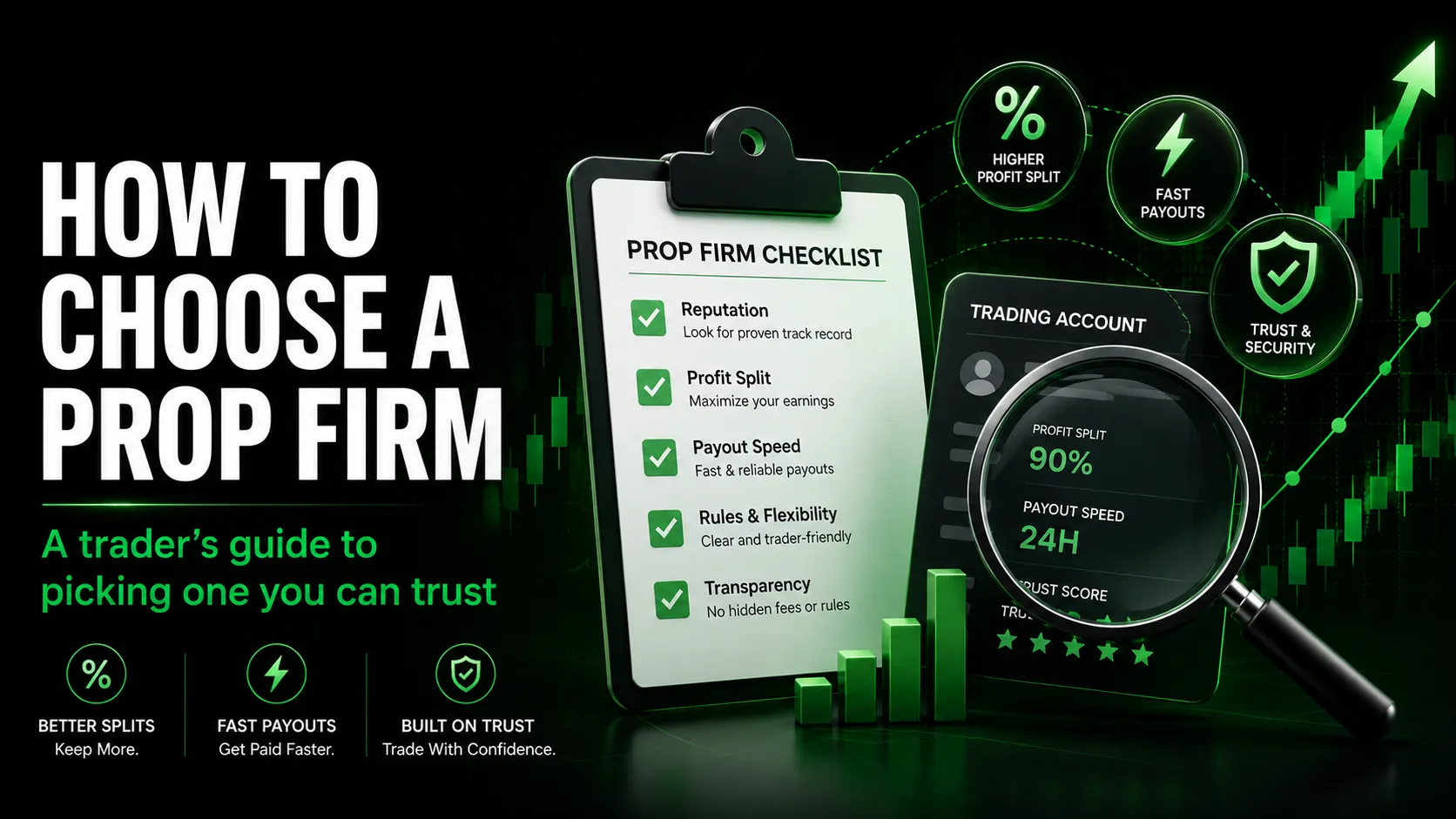
When comparing prop firms, don’t get distracted by flashy marketing. Focus on these six factors:
1. Profit Split
This is the percentage of profits you keep. The industry standard ranges from 70% to 90%, though some firms advertise „up to 100%.“ Always check whether that top split is standard or an expensive add-on.
2. Payout Speed
How fast do you actually get paid? Some firms process payouts in 24 to 48 hours; others take weeks. Fast, reliable payouts are one of the clearest signs of a trustworthy firm.
3. Drawdown Rules
Every firm sets a maximum loss limit (overall) and often a daily drawdown limit. Breach either, and you lose the account. Understand exactly how these are calculated — trailing vs. static drawdown makes a huge difference.
4. Evaluation Type
Firms offer 1-step, 2-step, or instant-funding models. A 1-step challenge is faster but usually stricter; instant funding skips the evaluation but often comes with tighter consistency rules. Pick what fits your trading style.
5. Trading Conditions
Can you trade the news? Hold positions over the weekend? Use Expert Advisors (EAs)? These rules matter enormously depending on your strategy — and breaking one can wipe out your account instantly.
6. Restricted Countries
Many firms don’t accept traders from certain countries. Always check the eligibility list before you buy a challenge.
Red Flags to Avoid
Steer clear of any firm that:
- Hides its rules or makes them hard to find
- Has no verifiable payout proof from real traders
- Promises „guaranteed“ or „risk-free“ funding
- Has been operating for only a few weeks with no track record
- Relies entirely on influencer hype rather than transparent information
How to Research a Firm Before You Buy
Here’s the part most traders skip — and later regret. Before committing to any challenge:
- Read independent reviews, not just testimonials on the firm’s own site.
- Look for real payout proofs — actual screenshots of traders getting paid.
- Compare the rules side by side against other firms in the same price range.
- Start small. Buy the smallest account first, complete one full payout cycle, and confirm the firm actually pays before scaling up.
This last point is the single most valuable habit a prop trader can build. Testing the payout process on a small account is the cheapest insurance you’ll ever buy.
Where to Find Verified, Unbiased Information
The challenge is that most „reviews“ online are affiliate content designed to sell you a specific firm. To make a genuinely informed decision, you need independent, editor-verified data.
Platforms like Propiffy have emerged to fill this gap. Propiffy is an independent directory that reviews, ranks, and audits prop firms — verifying challenge rules, profit splits, payout speeds, restricted countries, and real trader payout proofs before anything goes live. Instead of trusting a firm’s marketing, you can compare firms side by side, see verified payout evidence, and even use tools like a prop firm finder to match a firm to your budget and trading style.
Resources like this take the guesswork out of the decision — which, in an industry this crowded, is exactly what traders need.
Final Thoughts
Getting funded is an exciting milestone, but it’s only worth it if the firm behind you is legitimate. Take the time to understand the rules, verify the payouts, and start small. The traders who do their homework are the ones who last.
Choose carefully, trade responsibly, and never risk more than you can afford to lose.